

AI product engineer · Telco & ISP (external)
Check the commands sent by your router-support agent
Test outage checks, customer confirmation and the device command behind a router restart.
Key takeaways (3)
- Check the device command as well as the assistant’s reply.
- A known outage or unavailable outage feed stops device changes in this example.
- Test a deliberately broken command mapping before connecting a real router.
A customer asks your support assistant to restart their shop router. They expect a short interruption, with the Wi-Fi name and password unchanged. Your test needs to inspect what reaches the device: the adapter could send a factory reset even while the assistant describes a restart.
You will run Juniper Mobile’s fictional router example, trace a chosen restart to its command log, and deliberately break one command mapping. The deliberately broken version still reports that settings were kept. You will see why that reassuring check can pass and which command assertion catches the fault.
You need Git and Python 3.11 or later. The command tests use Python’s standard library. They need no model key, Rasa licence or router. The service, customer and devices are synthetic; the results below concern local Python behaviour.
Run the restart checks
Use a fresh checkout so you can undo the deliberate change later:
git clone https://github.com/RasaHQ/rasa-community-resources.git
cd rasa-community-resources
git checkout 4aa0c4419dc193fef7a969c12d59edcf720f2606
cd examples/mantle-text-telco-diagnostics-gpt
python3 -B -m unittest discover -s tests -p test_guard.py -k RunTests -v
Expect nine tests and a final OK. This is the completion criterion for the
command, not a claim that a router or model was tested.
The restart tests
check the stored selection, the displayed interruption notice and the eventual
command. A successful restart produces one REBOOT entry and keeps the
simulated settings. Calling the same selection again returns its receipt
without adding another command. The successful-restart test contains these
assertions against the returned command receipt:
self.assertEqual(result["confirmed_operation"], "reboot")
self.assertEqual(result["command_sent"], "REBOOT")
self.assertEqual(result["commands_sent_this_conversation"], ["REBOOT"])
The write function builds that receipt from the same command it appends to
net.command_log. This inspects a local recorder, not an independent device
acknowledgement. The middle assertion is the one the deliberate mapping edit
will break.
If discovery reports zero tests, check that your working directory is the example folder and that the checkout matches the revision above. These tests do not install Rasa. The full suite has additional SDK checks which may skip when its optional dependencies are absent.
Follow the operation to the device
The example separates read-only support from changes to a router:
| Customer’s task | What the example permits |
|---|---|
| Check an outage or line readings | Read-only tools; no device command |
| Restart the router | Select a reboot, show its interruption notice, then obtain confirmation |
| Erase the router’s settings | Require an explicit request for a factory reset, then a separate confirmation |
| Ask to “reset it” | Ask which operation the customer means |
The outage skill has no device-changing tools. The recovery skill first checks the outage feed. A known outage stops local recovery steps. An unavailable feed also stops them under this example’s policy and offers another check or a technician route. Your network-service owner must decide the appropriate policy for a real system.
When the customer chooses a restart, the selection function saves the service, operation and interruption notice under a selection reference. The Rasa wrapper stores that reference in skill memory. Its confirmation gate holds the tool call while the customer is asked whether to proceed.
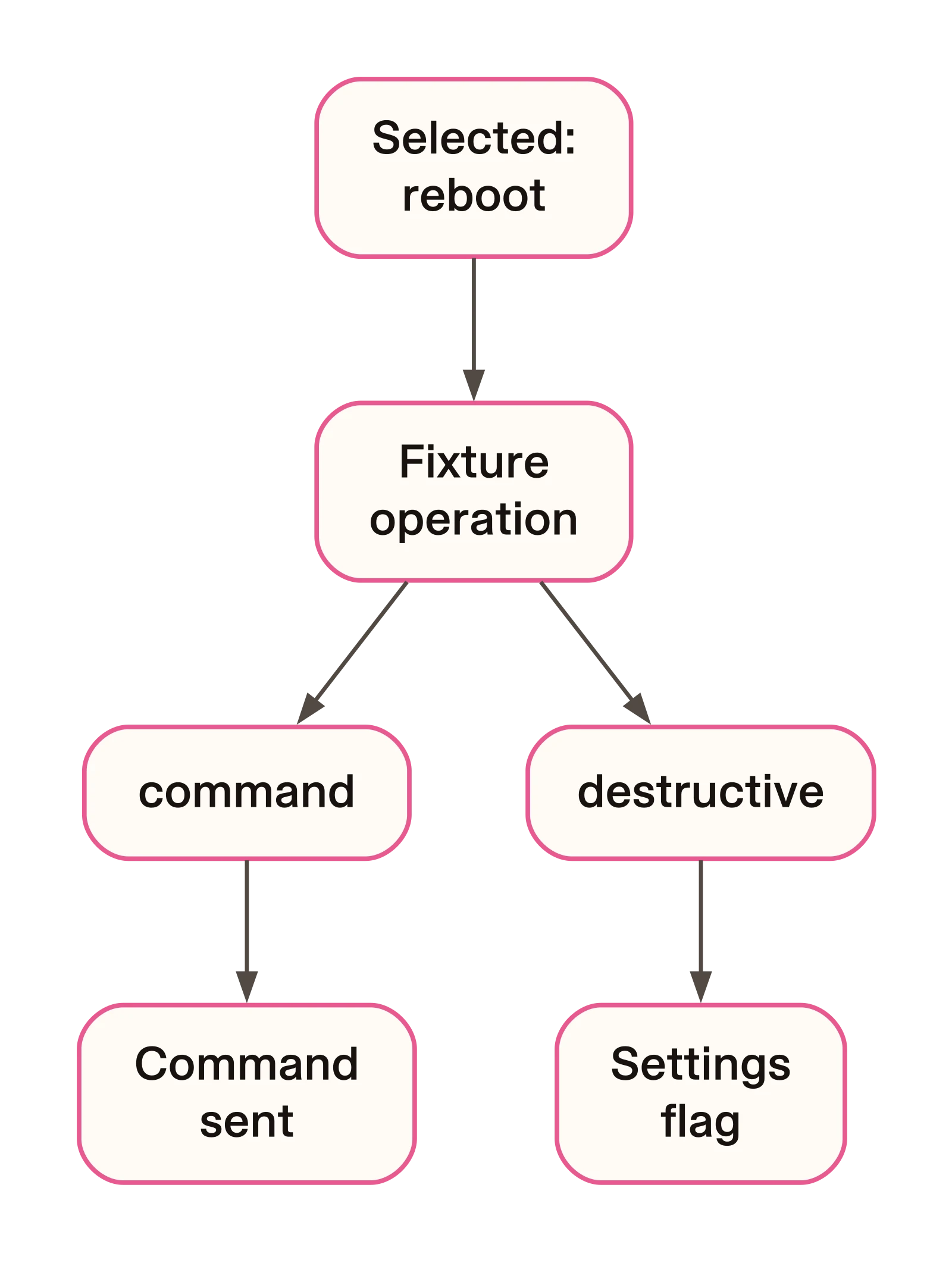
The final mapping is still part of your application. A valid selected operation does not establish that the mapping sends the intended device command. That is what the next test checks.
Break the mapping deliberately
Open lib/fixtures/juniper.json. In the operations object, find reboot and
change only its command value from REBOOT to FACTORY_RESET. Keep the label,
interruption notice and destructive value unchanged. You are simulating a bad
adapter mapping in this local fixture.
Run the focused command assertion:
python3 -B -m unittest discover -s tests -p test_guard.py \
  -k test_confirmed_reboot_sends_exactly_one_reboot -v
The test must fail because the emitted command differs from REBOOT. An
assertion that checked only the chosen operation would miss this edit: the
selection still says reboot. Even the fixture’s settings_kept field follows
the unchanged destructive flag, so it cannot independently verify a router’s
actual settings.
| Check | Original mapping | Deliberately broken mapping |
|---|---|---|
| Chosen operation | reboot | reboot |
| Command mapping | REBOOT | FACTORY_RESET |
| Command assertion | Passes | Must fail |
If the mutated test stays green, inspect the file you edited and the reported test count. Do not treat a run with no selected tests as evidence that the mapping is correct.
Inspect a reassuring check that misses the fault
Keep the deliberately broken mapping for this step. Python’s included debugger can pause the test before it checks the returned command:
python3 -B -m pdb -m unittest discover -s tests -p test_guard.py \
  -k test_confirmed_reboot_sends_exactly_one_reboot -v
At the debugger’s (Pdb) prompt, pause at the operation-name assertion, after
the local write has returned. The line number is specific to this checkout.
b tests/test_guard.py:183
c
Now result is the local write function’s return value. Inspect a deliberately
incomplete check that trusts only the operation name and settings flag:
p result["confirmed_operation"] == "reboot" and result["settings_kept"] is TrueIt returns True. Check the command separately:
p result["command_sent"]
p result["command_sent"] == "REBOOT"
The command is FACTORY_RESET; the comparison returns False. Enter c to
let the existing assertion fail, then q to leave the debugger. The debugger
can exit normally after a failed test; its own exit status is not a test verdict.
This incomplete comparison is constructed for the exercise. It is not a
pre-existing faulty test: the example already has the stronger command
assertion. The result explains why a success flag deserves scrutiny. The
simulation calculates settings_kept from its separate destructive flag;
it does not observe an actual router after applying the command.
| Observation after the deliberate edit | Result |
|---|---|
| Operation name is reboot and settings flag says kept | True |
| Command returned by the recorder | FACTORY_RESET |
| Command equals the expected reboot command | False |
Restore the fixture in this fresh checkout, then repeat the focused test:
git restore -- lib/fixtures/juniper.json
python3 -B -m unittest discover -s tests -p test_guard.py \
  -k test_confirmed_reboot_sends_exactly_one_reboot -v
git diff -- lib/fixtures/juniper.json
Expect a passing test and no diff for the fixture. Keep your real integration’s equivalent command assertion when replacing the simulated service.
Recorded offline result
The recorded check on 15 October 2026 used the pinned source above. The full suite included its SDK-dependent assertions in an existing Rasa environment; the focused restart exercise itself needs only Python.
| Run | Observed result |
|---|---|
| Full original suite | 30 tests passed; none skipped |
| Restart checks shown above | Nine tests passed |
| Changed command mapping | One test failed on the command assertion, as intended |
| Restored original fixture | The focused test passed again |
The deliberately broken version produced:
AssertionError: 'FACTORY_RESET' != 'REBOOT'The source snapshot was restored byte for byte. These runs called no model or speech provider and sent no device command outside the local recorder. The saved test output records those local results; it does not establish a real router’s behaviour.
Keep confirmation and command checks separate
These tests construct a transcript containing the interruption notice and a
later customer reply. The local boundary_confirmed helper checks that order;
it does not understand whether the reply means yes. Rasa’s confirmation path
receives the model’s separate boolean decision.
Consequently, the direct Python tests do not establish that a model interprets “no”, a changed device or a different requested operation correctly. Test those turns through your agent before connecting a device. Record both the proposed operation and the actual command, and check that cancellation sends nothing.
Check your reasoning
The command identifies the fault. The reply and selection describe the intended operation; neither proves the adapter sent it. In this exercise the log is a local recorder. With a real router, inspect the provider request and independent device acknowledgement, then test any relevant settings afterwards.
The local replay check also has a limit: its command history lives in memory. It cannot prevent duplicate commands after a server restart or across several workers. A production adapter needs durable operation identifiers and a way to look up uncertain outcomes before retrying.
For the optional running Rasa agent, use the pinned setup guide. That path installs dependencies and requires separate licence and model access. The offline exercise above makes no claim about its chat accuracy, speech quality or a real network’s recovery rate.