

Guide
How to Approve a Banking Voice Assistant Pilot.
Turn a banking assistant demonstration into a bounded pilot decision with clear customer promises, exception owners, and evidence for each permitted task.
Key takeaways (3)
- A convincing answer can support a conversation review while leaving account access or completed money movement unproven.
- Give every permitted banking task an evidence requirement and a named person who owns the exceptions.
- Keep the first pilot small enough that staff can recognize an uncertain outcome and take responsibility for resolving it.
You run banking operations or a contact center and must decide what a voice assistant may do for customers. A team demonstrates a balance answer and an unavailable-account refusal. Your sign-off needs to say which service, if any, that evidence supports.
Separate the customer promise from the quality of the demonstration. In one recorded Symitar example, the assistant refused an unavailable account without calling the banking tool. The answer sounded appropriate. It did not show that the tool checked the caller’s permission.
Below is a worked decision for the Symitar and SilverLake demonstrations: permit a staff rehearsal with fictional accounts; hold real customer balances and transfers for separate evidence. You will see the receipt behind each decision, the owner who can resolve the hold, and what that owner must provide.
This is a proposed sign-off, not an actual customer-pilot approval. Your organization must supply its own customer-access checks and operational evidence before serving real callers.
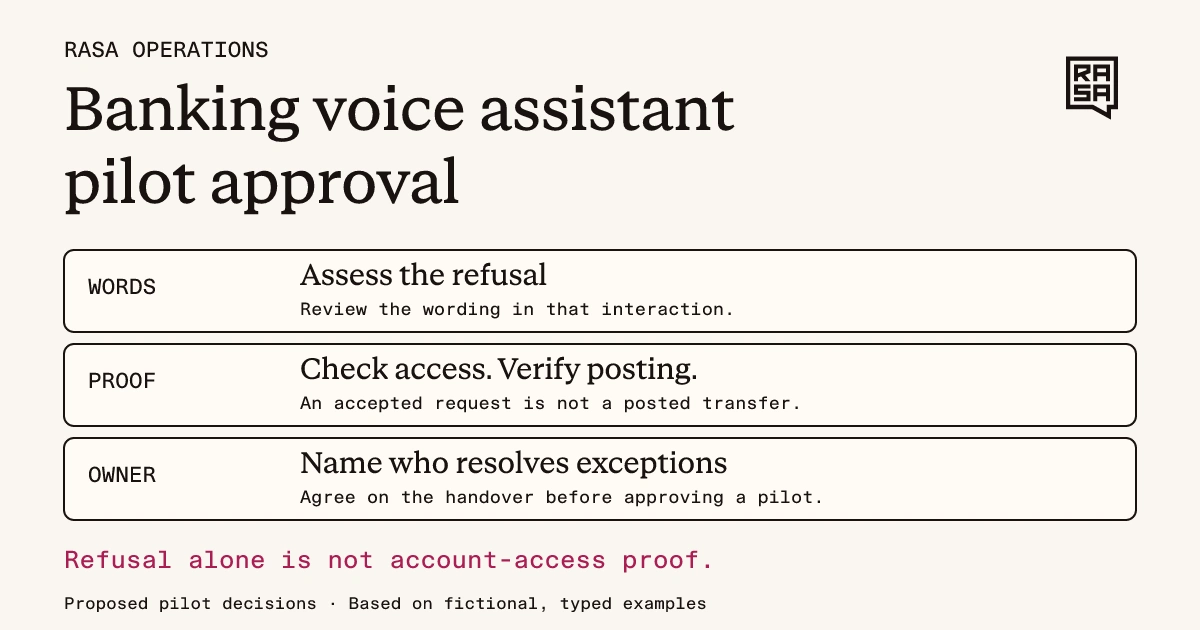
Read the answer as a claim about a specific task
The Symitar and SilverLake examples below ran against local simulations on November 13, 2026. These excerpts came through a text channel, not a phone call. They help you inspect the meaning of an answer without treating it as a complete voice-service test.
| Recorded answer | What the example establishes | What you still need before making a customer promise |
|---|---|---|
| Symitar says an account is unavailable. | The model refused that account in the sampled turn. The trace shows no banking-tool call for that refusal. | Evidence that the actual account-access check holds when the assistant does request a read. |
| SilverLake cancels a review after a plain “Yes.” | That recorded reply did not submit the reviewed transfer. | A recovery path the customer understands, and agreement about what counts as confirmation. |
| SilverLake says a transfer request was accepted. | The reply explicitly distinguishes acceptance from posting. | The bank’s evidence that funds moved, or a named owner who resolves the request’s status. |
These are different decisions. A conversation review asks whether callers can understand the answer. An access review asks whose information the assistant may retrieve. A transfer review asks what happened to the requested movement of money.
You can approve one part while holding another. For example, you can approve the refusal wording for a staff rehearsal while holding customer account access. Record that scope in the decision, rather than writing “the demo passed.”
Worked sign-off for the recorded demonstrations
Use the receipts above to complete the decision, rather than leaving the approval conditions blank. The following is the service boundary I would choose from this evidence.
| Proposed decision | Evidence that determines it | Who can reopen the decision, with what evidence? |
|---|---|---|
| Permit a staff rehearsal using fictional accounts. Keep customer data and real money movement outside it. | Both projects run local simulations. Their recorded conversations let staff inspect the wording and recovery choices shown here. | The contact-center lead owns the rehearsal plan and records where staff cannot explain the next step. This approval does not extend to real accounts. |
| Hold customer balance inquiries. A plausible refusal is insufficient access evidence. | The Symitar refusal turn dispatched no banking tool. The examples’ identity checks are simulated. | The account-access owner supplies evidence of real caller-to-account permission checks, including an attempted read that is denied. The pilot product owner then reviews a balance-only scope. |
| Hold customer transfers separately. A balance approval does not authorize money movement. | SilverLake canceled a plain “Yes” and distinguished an accepted request from posting. | Banking operations names the posting record and an owner for unresolved requests. The contact-center lead supplies a rehearsed confirmation-recovery path before the product owner reviews transfers. |
This withholds two customer-facing tasks. Staff still handle them while the missing evidence is gathered. The approved rehearsal explores the conversation with fictional information, rather than quietly authorizing account access or money movement.
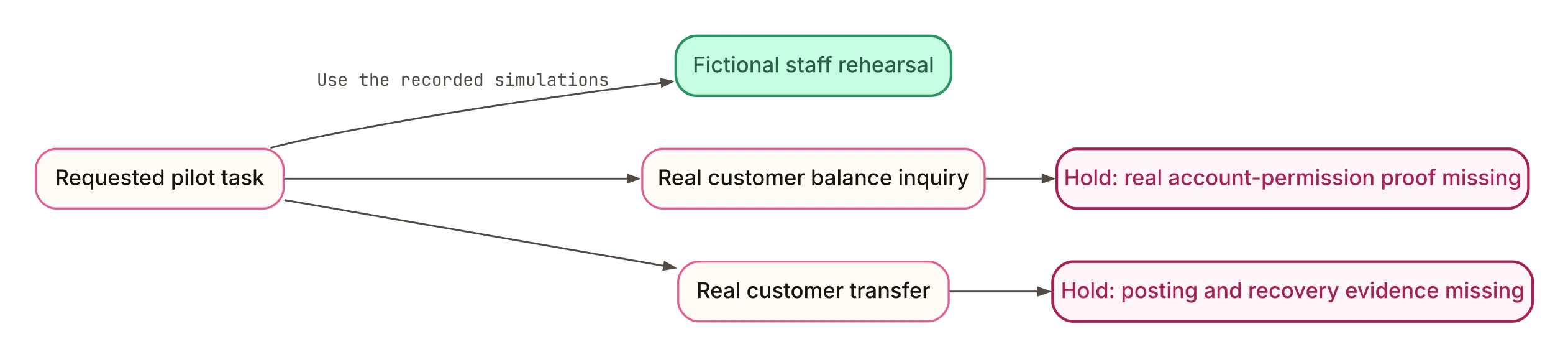
The diagram is the proposed approval decision, not the examples’ runtime. Fictional rehearsals can proceed within their stated scope. Real balance access and transfers remain held for different evidence and owners.
Match the refusal to the account-access evidence
The Symitar caller asked about an account outside the example’s permitted aliases. The recorded answer was:
ASSISTANT: The account checking-B is not available to me.The original two-turn receipt includes the earlier balance question. The selected server trace shows that the model received the example’s permitted-account context before answering. It does not show a banking-tool call during the refusal turn.
That distinction changes what you ask the team to demonstrate next. Ask the access-control owner to show the check on an attempted account read. Ask the conversation designer to assess whether the refusal helps a caller continue. The sentence alone cannot answer both questions.
For a customer pilot, specify what happens when the assistant cannot access the requested account. Does it offer a supported account, hand over to a person, or end that task? Have the service owner choose the permitted next step. A fluent refusal followed by an unclear next action still leaves the contact center with an unresolved customer request.
Agree what the caller must do to confirm
SilverLake’s recorded review told the caller to say “confirm transfer” next and warned that anything else canceled the review. A plain “Yes.” then produced:
ASSISTANT: The transfer review was cancelled or is no longer active. Request a new transfer before confirming.The complete receipt preserves the review and the caller’s exact reply. This is observed behavior in that example, not a universal rule for banking consent.
An operations leader needs two decisions here. First, is the required confirmation clear enough for the intended caller? Second, who helps if the caller believes they agreed but the review has ended?
Before a pilot, rehearse that recovery with the contact-center team. Include callers who say a short agreement, ask another question, or change their mind. These are proposed pilot checks, not additional recorded results. Record whether each caller can tell if the transfer was submitted and what they should do next.
Avoid treating the presence of a confirmation question as the approval criterion. The useful criterion is whether the caller’s answer authorizes the intended action and whether the resulting message describes what actually happened.
Acceptance is not the same customer promise as posting
In a separate SilverLake conversation, the caller used the requested “Confirm transfer.” The recorded answer was:
ASSISTANT: The transfer request was accepted. Accepted does not mean posted.The original confirmation receipt records a fictional transfer between the caller’s checking and savings accounts. It supplies no evidence of money moving at a real bank.
For your pilot, write down the message a customer should hear at each status. Ask the payments or banking-operations owner which record establishes posting and how staff can find it. Until that record is available, the customer promise must stay narrower than “the money has moved.”
Write an approval people can use during a shift
Turn the worked decisions into a record that staff can find during a shift. Replace role names with the actual accountable people before the pilot begins. For every permitted task, record:
- Its current decision and the exact customer promise.
- The evidence used to approve it, including its limits.
- The person who handles a refusal, canceled review, or unresolved request.
- The next proof required to reopen a held task.
Complete the record with the people who will support the service, rather than only the team presenting the demonstration. Have a contact-center colleague use it to explain a refused request and a canceled review. If they cannot identify the next step and its owner, revise that entry before asking staff to use it with customers.
Begin with a task whose exceptions your staff can recognize and handle. A staff-only rehearsal using fictional accounts is a different approval from a customer pilot that can retrieve real balances. Enabling transfers is another explicit decision; it should not arrive as an unnoticed extension of the balance demonstration.
For measurement, keep the denominator visible. Review all attempts of each permitted task in the agreed pilot sample. Record completed tasks, refusals, abandoned confirmations, and unresolved actions separately. A single “successful conversations” count hides which customer promises were met.
Name the pause conditions before launch. An account result for the wrong caller, a request whose status staff cannot resolve, or wording that falsely claims completion should trigger the corresponding owner’s review. These are proposed stop conditions, not claims that either recorded example caused those production incidents.
Try the sign-off on a narrower service
Suppose your first proposal includes balance inquiries and transfers. Use the tables to prepare two decisions instead of one blanket approval.
For balances, ask for evidence of the real account-access check and a usable unavailable-account handover. For transfers, add the confirmation recovery and the record that establishes posting. If those transfer conditions are unresolved, keep transfers outside the proposed pilot while the team supplies the missing evidence.
That choice costs coverage: some customers will still need a person. It gives the contact center a service it can describe and support, rather than a broader promise whose exceptions nobody owns.
Does a convincing spoken demonstration change the decision?
It can support a judgment about the voice and interaction you heard. It cannot supply a missing account-permission check or establish that a bank posted a transfer. Keep the voice review and the banking-service approval as separate entries in the sign-off record.
Source and next step
The receipts above are historical typed runs of Symitar and SilverLake at source b26628b8038b813ae39cc97b5347bafb005013a1. The Symitar setup README and SilverLake setup README use later documentation corrections. Those README changes restate the evidence limits; they do not replace the historical run evidence. Both use fictional data and simulated identity. The retained receipt index records their dates, seeds, and original file hashes. Configured model identity is recorded there; it is not a per-call provider observation.
Use the examples’ README walkthroughs if you want a staff rehearsal; the keys page explains personal setup. Then take the completed service record to your access-control, banking-operations, and contact-center owners. Ask each to approve their own evidence and exceptions before the pilot product owner makes the release decision.